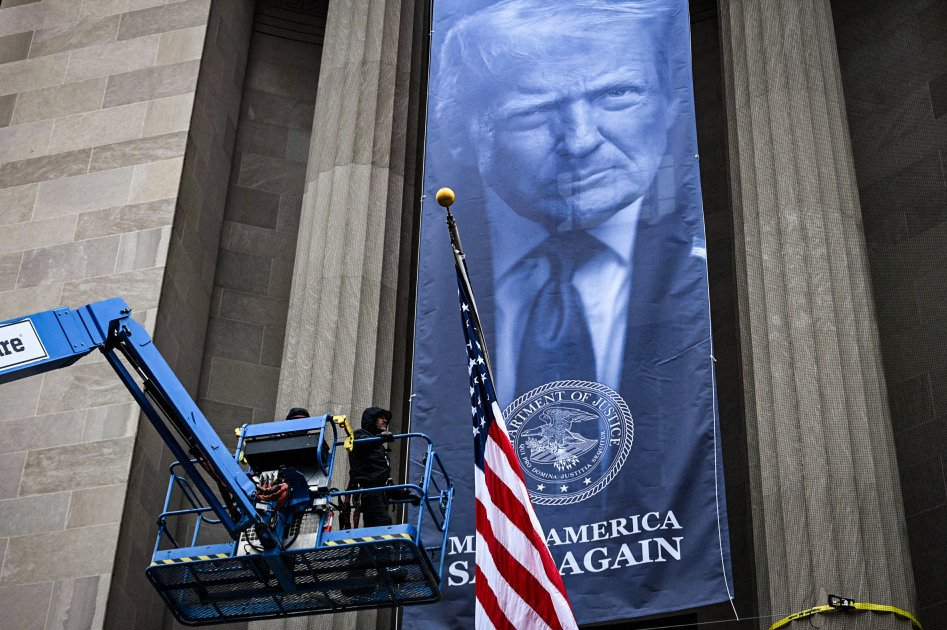
For a Bully Guy
The United States first heard the term “bully pulpit” in the early 1900s when President Theodore Roosevelt boasted about his.1
By “bully” Roosevelt meant — and was understood to mean — “very good” or “excellent.” The 26th president of the United States was well aware of the incomparable platform his office afforded him to influence public opinion. During his time at the pulpit — 1900 to 1909 — he promoted regulation of large corporations, conservation of natural resources, protection of forests and wildlife, an eight-hour workday for federal employees, and minimum wage standards for working women. He also advocated for the right of the United States to intervene in Latin American affairs.2 Being a tool of the man in office, the bully pulpit amplified the bad along with the good.
If President Donald Trump ever heard the term “bully pulpit” — which he likely has not — there is zero chance he would have known what it meant in Roosevelt’s day. Were he to run across the term now, he would assume it had been coined to describe him and his brand of communication. So would many others, the term so perfectly describes Trump’s use of his office to shake down individuals, organizations, and nations.
Ideas to animate a crowd are best conveyed if the crowd knows nothing about any charmed podium. The potentate’s message is to be absorbed not as opinion or preaching, but as truth.
Roosevelt didn’t realize that crowing about his bully pulpit could diminish its effect. Dictators do. Ideas to animate a crowd are best conveyed if the crowd knows nothing about any charmed podium. The potentate’s message is to be absorbed not as opinion or preaching, but as truth.
To maximize bully pulpit power, the wise dictator conducts a clandestine shutdown of channels carrying contrary messages. Because this stranglehold on information was foreseen as an impediment to democracy, the First Amendment of the U.S. Constitution declared: “Congress shall make no law . . . abridging the freedom of speech, or of the press.”
Untroubled by amendments — indeed, unaware of them — America’s number one dolt, Trump, tore right through the facade of an American free press by publicly threatening mainstream media with legal action if their content did not align with his preferences. In one case, he demanded control of their content.3
Despite America’s apparent abundance of channels and choices, Trump’s capture of the media was child’s play. The industry is owned by five billionaire crap shooters4 who, it so happens, are not interested in news at all, but profitable content. And they learned the most profitable content is not news, but entertainment and — suddenly — resonance with Trump’s bully pulpit. Under Trump’s threats they readily handed him millions in cash and services with an apology and a tacit promise to provide coverage that pleases him. Their business outlooks brightened. The victor naively trumpeted his conquest: “PRESIDENT TRUMP IS RESHAPING THE MEDIA.”
Yet, the president’s control of the media isn’t extensive enough or conspicuous enough for fellow dolt, Pete Hegseth, who railed against unflattering CNN coverage: “The sooner David Ellison takes over that network, the better.” A third dolt, FCC chairman Brendan Carr, threatened to revoke broadcasters’ licenses for “running hoaxes and news distortions” about Trump’s Iran war.
The deplorable state of American media provoked Chas W. Freeman Jr., retired career diplomat, to say, “We have an uninformed public. . . . We need a freer media. We need an antitrust policy against the oligarchization of our media. And we need to rediscover reality. The reality we perceive is what we’re given, masticated by corporate elements and projected on the television screen. That is not reality.”5 Constitutional scholar Bruce Fein added: “[Trump] told the New York Times, ‘The only thing that restrains me is my moral conscience,’ which we know doesn’t exist . . . He’s openly said this, and it’s truly stunning that the media listens and then it goes away. This is a homicidal maniac that we got in the White House. And they have these euphemisms and headlines.”6
Two additional echo chambers Trump snatched for himself are national park and museum exhibits that narrate the country’s history to schoolchildren.
Dictators of the past had no idea to what extent a modern echo chamber could amplify their bully pulpit. Trump does. He set up his own social media platform in 2022.7 Newly reelected in 2024, he shed experts and specialists to staff his administration with sycophants too green to mind the odor of corruption. Besides the media moguls, Trump brought to heel law firms, universities, and the algorithmic brotherhood of high tech with similar threats of ruin only a malevolent autocrat could and would carry out. With his choir in place, Trump proceeded to govern by executive tweet. Congress squirmed on the sidelines, but beamed radioactive smiles his way, knowing he would primary them out of existence if they so much as winced at his flagrant abuse of power.
Trump’s strongman tweets — those executive orders — purport neither to be legal nor constitutional.8 The federal courts are left with the task of pinpointing any irregularities they may contain. Because such determination involves months of painstaking work, the laboring courts trail farther and farther behind Trump’s rapid-fire EOs. Judicial constraint comes years later if at all by which time Trump has started another war or “taken” Cuba, which only kicks off another lengthy, expensive legal check that will, at some point, exhaust judicial resources.
Two additional echo chambers Trump snatched for himself are national park and museum exhibits that narrate the country’s history to schoolchildren. To promote his benighted version of U.S. history, Trump ordered the description of Harriet Tubman and the Underground Railroad to be rewritten to depict it as a successful, mutually profitable cooperation between Blacks and Whites.9 Few young minds enjoying a rare school outing will think to question a Smithsonian Institute display. Let that remove any doubt for those still wondering: Trump does indeed prey on minors.
A deputy national security adviser justified Trump’s unprovoked aggression against Iran far better than Trump could ever do.
Trump’s echo chamber extends to highly educated, disciplined experts. Consider Nadia Schadlow, deputy national security adviser during Trump’s first term. In a recent interview with Ezra Klein,10 she justified Trump’s unprovoked aggression against Iran far better than Trump could ever do. Her remarks, seemingly grounded in substance and experience, were saturated with the Trump potion. She told Klein calmly: “Congress does not have a constitutional role in the declaration of war.”
Klein responded as calmly: “I mean, here, I will quote the Constitution. The Congress shall have power ‘to declare war, grant letters of marque and reprisal and make rules concerning captures on land and water.’ The president should be the commander in chief of the Army, but it is Congress that has the power to declare war. So constitutionally, the Constitution says Congress has the power to declare war.”
Schadlow clarified: “But the issue is whether or not a president who deploys military force abroad needs to do so only after having Congress declare war. There are arguments by constitutional lawyers like Robert Turner and John Yoo who argue that the issue has to do with the term ‘declaration’ and what was meant by ‘declare’ versus the president’s ability to deploy U.S. forces around the world.”
While her explanation may sicken some listeners, we can be sure this is exactly what Trump hears from his sycophants — even the expert sycophants — on an hourly basis. Would a Donald have any chance to make reasonable, let alone wise or prudent, decisions listening to that?
The costly, childish disruption of the American election process was unleashed by two Supreme Court decisions.
The only serious competition the bully pulpit faces is the periodic clamor that rages during political campaigns. These high-powered ruts are well known not for informing, but infuriating voters, which is their aim. Each campaign message is a result of extensive research to uncover the current flash points that will anger voters and most likely capture their votes. Small fortunes are spent for the research and the skill required to craft each message. But to ensure the message stays top of mind for a campaign that can last weeks, it must be seen, heard, and echoed incessantly. Accordingly, it must be flashed across the most heavily trafficked media channels, an outlay that sends campaign costs into the stratosphere. Because well-funded sources report that voters usually succumb to the best-funded candidate,11 the game only intensifies every campaign cycle.
This costly, childish disruption of the American election process was unleashed by two Supreme Court decisions. In 1976, the Buckley v. Valeo decision ruled that political spending is protected by the First Amendment right to free speech. Thirty-four years later, the notorious 2010 Citizens United decision ruled that corporations were “associations of citizens” and consequently possessed the collected rights of those citizens — including free speech. Put those two rulings together with the fact that corporations have mountains more money than individuals and presto! Corporations have more free speech than just about anyone, which they exercise to the max.
That’s not quite the end of the story. Corporations acquire free speech rights from the citizens they represent, but those citizens — corporate CEOs and directors and stockholders — retain their free speech rights to exercise independently as well. This selective amplification of free speech rights undercuts the unaugmented rights of the average citizen.
Another twist is that corporations carefully focus their hefty campaign spending, regarding it as a crucial business investment. Once in office, their candidate all too reliably introduces and supports legislation that benefits the corporate bottom line. No individual citizen would see their modest campaign spending in that light.
Low-information white voters with a “low need for cognition” were most likely to have high levels of hostility to anyone they perceived to be outside their group.
If we weren’t vulnerable to campaign ads, outsize election spending would be something to giggle about. But we are vulnerable. The question is why we allow ourselves to be bamboozled election after election when we know those by campaign ads are angling for our vote any way they can. Paul Krugman recently explained that billionaires’ campaign money captured low-information voters for Trump and his allies.12 As “low-information” voters make up between 20% and 25% of the U.S. electorate, that can make all the difference.
So who are low-information voters? Not us, surely. Low-information voters are characterized as highly susceptible to emotional appeals and simplified messaging, making them perfect targets for high-priced political campaigns focused on swinging elections. More chillingly, low-information white voters with a “low need for cognition” were most likely to have high levels of hostility to anyone they perceived to be outside their group.13
Voter hostility should not surprise us. We American voters have been groomed for belligerence all of our lives. First of all, we know we’re exceptional, that we are better than the rest of the world, that we live in the richest country in the world, have the highest standard of living in the world, fought harder for freedom way back when, created the freest society, love freedom more than anyone else, are freer than anyone else, and will let no one take our freedom away. We are also aware that our superior moral authority gives us the right to shoot anyone who tries right between the eyes or annihilate their capitals and national treasures, if need be.
We pick the best leaders in the world because we are the smartest, best-educated, best-informed electorate in the world voting in the freest elections in the world and, of course, we picked Trump because we could feel in our bones he would tell all those other countries to shape up or be blown to bits by our all-powerful military machine, after which we will march right in there, wipe out the terrorists left squatting in tents, and lift something out of that rubble worth living for, and have just the visionary to do it, Jared Kushner.
That is American jingoism, and it’s wearing thin for most of us. We are tired of Trump’s bully pulpit. But guess what? Trump is tired of it, too. Our barnyard genius14 has got something else in mind to drench his recalcitrant nation in loyalty and obedience. Trump posters! Draped over buildings nationwide, their ubiquitous presence will serve to remind us that Trump is watching over us and keeping us safe because his marvelous EOs will continue to expose the worst domestic threats of our age. And guess what? It’s not Big Brother.
- “I suppose my critics will call that preaching, but I have got such a bully pulpit!” journalist Lyman Abbott reported Roosevelt as saying. ↩︎
- Called the Roosevelt Corollary to the Monroe Doctrine. ↩︎
- In filing his $20 billion lawsuit against CBS, a motion to dismiss filed by parent company Paramount states: “They not only ask for $20 billion in damages but also seek an order directing how a news organization may exercise its editorial judgment in the future. The First Amendment stands resolutely against these demands.” https://www.theguardian.com/us-news/2025/mar/07/paramount-cbs-60-minutes-trump-lawsuit ↩︎
- The primary five entities dominating U.S. media: Comcast (NBCUniversal), Walt Disney (ABC/ESPN), Paramount Skydance Corporation (CBS), Fox Corporation (Fox News), and News Corp (The Wall Street Journal). Warner Bros. Discovery (CNN, HBO) had been a sixth player until its takeover by Paramount in February. ↩︎
- https://open.substack.com/pub/ralphnader/p/war-with-iran?utm_campaign=post-expanded-share&utm_medium=web, 1:25:57 ↩︎
- Ibid, 1:29:50 ↩︎
- Truth Social “was launched in February 2022, created in response to Trump’s bans from major social networks after the January 6 Capitol attack. It is a self-styled ‘free-speech’ alternative to mainstream platforms, catering primarily to a conservative and pro-Trump user base. Since mid-2022, it has faced financial and regulatory issues. It was unavailable on Google Play because of policies prohibiting content with physical threats and incitement to violence, but approved in October 2022 after agreeing to enforce policies against incitement.” Truth Social, Wikipedia. ↩︎
- Executives orders end with text like “This order shall be implemented consistent with applicable law. This order is not intended to, and does not, create any right or benefit, substantive or procedural, enforceable at law or in equity by any party against the United States, its departments, agencies, or entities, its officers, employees, or agents, or any other person.” In other words, executive orders are not laws nor do they affect existing laws. During his administration, Trump has reduced them to executive blather. ↩︎
- https://www.washingtonpost.com/investigations/2025/04/06/national-park-service-underground-railroad-history-slavery/ ↩︎
- https://www.nytimes.com/video/opinion/100000010758672/i-asked-a-former-trump-official-to-justify-this-war.html?smid=nytcore-ios-share ↩︎
- https://represent.us/explains/how-money-influences-elections/ ↩︎
- http://paulkrugman.substack.com/p/the-billionaires-war?utm_source=substack&utm_campaign=post_embed&utm_medium=web ↩︎
- Hard White: The Mainstreaming of Racism in American Politics, Richard C. Fording and Sanford F. Schram, 2020. ↩︎
- “Stable genius” was his original designation of his superior mental faculties. ↩︎