The pursuit of truth is no activity to engage in every day. It is fatiguing and can be unpleasant. Those searching must proceed painstakingly while keeping in mind that their ability to detect truth — or comprehend it if they do — may be inadequate. We must also be prepared for comeuppances. What if we happen upon truth we don’t like? Controversy is near zero that truth is anything but good. If we don’t like truth, we don’t like good. If we don’t like good, what is to become of us?
No worries. We have long since learned to adjust truth for comfort. Bypassing the primitive stratagems of a Cinderella stepsister who cuts off a toe to fit her foot into someone else’s slipper, we have learned to alter the shoe.
The need to discover truth emerged eventually and turned out not to be optional, but an essential tool for the survival of nations.
It is curious that we think we can detect truth at all. Human faculties were fashioned to perceive light, movement, food, danger, shelter. Truth was never an issue until long after our evolutionary chapter had wrapped up with our niche in the planet’s food chain secure.
The need to discover truth emerged eventually and turned out not to be optional, but an essential tool for the survival of nations. Governing a population with any success requires some knowledge of the limits of human endurance. When democracies came along, they offered something more than crowd control: justice. For that, they needed lawmakers adept at ferreting out subtler truths about human nature out of which to fashion just laws. But while the search for truth in and of itself is tough, determining truth by government committee is dicey indeed.
Luckily, U.S. politicians take an oath1 to support and defend, not truth, but the Constitution. While no easy task — we require a Supreme Court to figure out what that document says — it nevertheless constrains lawmakers’ search for truth and justice to that framework. Adhering to it means, however, they will never transcend it. Adherence also fosters hidden weaknesses. For example, small-minded allegiance has beguiled an entire political party to declare anti-capitalistic sentiments to be anti-American, hinting at traitorous undertones, surely not the truth and justice political champions seek.
Yes, our lawmakers pledge to be guided by the Constitution in their quest to write and pass the best legislation for the country, but their oath doesn’t mention voters. That is fortunate. There are so very many voters and they are all so different. Lawmakers may know what some voters think — their children, in-laws, parents, bowling buddies — but they certainly haven’t met all the voters. Those other voters most likely think something completely different, something maybe off the wall, which makes it perfectly impossible for them — oath-bound lawmakers though they be — to represent such a motley crowd. To keep those stymied legislators moving forward, a manageable number of deep-pocketed spirits have taken to hovering about the perimeter of those august legislative chambers to make their preferences perfectly clear to members within. These are the corporatists, whose unrelenting suggestions cause our legislators to defend absurd arguments and engage in distorted debates. Those lobbyists are highly successful in sneaking into the minds of heedful legislators the peculiar slant on Constitutional justice they feel is right for the country, and for the lobbyists themselves.
As justice advances, so do perspectives of justice.
In its task to establish just legislation based on Constitutional truth, the U.S. two-party system has generated murderously antagonistic visions of the world from which two irreconcilable versions of justice have been distilled.
Which version of justice prevails has immense consequences. In dictating what laws will bind people throughout the land, it defines the relationship of a government to its people and determines to what degree a population is uplifted or burdened. That, in turn, affects the character of a population. A highly successful administration with highly just laws will find the bar for justice continually rising as the perspective of what it means to be human advances along with scientific, technological, and cultural progress. Much Roman justice would be considered barbaric today. Athens was never faced with the decision of sacrificing the Rice’s whale species to oil drilling in the whale’s single habitat. The Xia Dynasty was spared the tough issues involved in forbidding transgender hormone therapy to preteens. We revile today the 19th century notion that slavery was the Black’s natural and normal condition. As justice advances, so do perspectives of justice.
The split vision of justice that hampers U.S. progress now is predicated on two opposing beliefs. The first holds that private property rights are foremost among human liberties; that preservation of private property, in safeguarding all other liberties, is key to American freedom; that, therefore, a government must, above all, protect and defend personal possession of property, no matter how copious.2
The second belief holds that accumulation of personal wealth should be limited to what the society can bear; that capping personal wealth is fully compatible with the guarantee of human liberties for all; that unrestricted accumulation of wealth, in fact, abridges the liberties of others insofar as such accumulation both creates and perpetuates a population of poor; that unrestricted personal wealth enables inordinate individual consumption that can monopolize and contaminate common good resources; that for the poor to regain full expression of their liberties under the Constitution, they must have opportunities to earn a living that result in some degree of independence.
In legislative terms, one version of justice fights to keep wealth in the hands of the wealthy. The second strives to achieve an equitable distribution of wealth among the population.
Rather than have Smith walk in and testify freely, the committee wanted it to appear that they had to rope, hog-tie, and drag him in.
The recent hearing to question former special prosecutor Jack Smith provides a good example of how our two political parties engage in their battle to determine truth and justice. Conducted by the House Judiciary Committee on January 22, 2026, the hearing was tasked not to establish a just law, but to inquire into whether established law had been faithfully followed. The object of the inquiry was Jack Smith’s 2024 investigation of then former president Donald J. Trump for election fraud. It had been alleged that during his investigation Smith had violated the law. To find out, the committee subpoenaed Smith and submitted him to five and a half hours of questioning.
Some peculiarities made one question their fact-finding methods.
The first peculiarity occurred weeks before the hearing was even scheduled. Catching wind of their concerns, Smith offered to come in and testify. That was a bummer for some on the committee. They ignored his offer, waited, then subpoenaed him. Rather than have Smith walk in and testify freely, the committee wanted it to appear that they had to rope, hog-tie, and drag him in. Subpoenas also come with the juicy threat of prosecution and possible prison time should the subject resist, circumstances of which Jim Jordan and Bill and Hillary Clinton are keenly aware.3 Some committee members gloated over the chance to make that happen for Smith, but he foiled them by appearing and subjecting himself meekly to a session of browbeating.
The second peculiarity of the hearing cropped up as soon as it started: how mad many committee members were at Smith before he answered any questions. Right out of the gate, Chairman Jim Jordan delivered a scorching invective, demanding fire-and-brimstone retribution be extracted from Smith. As others took their turn to question him, they gave him a good licking as well before asking him anything. Others spent the duration of their five minutes4 lambasting Smith without asking any question because they didn’t need to because they already knew how awful he was. Any question they did hurl at him was spiked with gratuitous, petulant slurs, which brings us to the third peculiarity.
Smith’s interrogators had no interest in hearing what Smith had to say. If, after they tore into him, they did question him, they shut him up the moment he opened his mouth. They knew all they needed to know about Smith and his wicked assault on President Trump, which raised the question of why they bothered with a hearing at all.
Jordan demanded that Smith state to the committee that Hutchinson had lied under oath. Great balls of fire! Smith was not a god; he could not possibly know.
For some reason, a sore point in the hearing was Cassidy Hutchinson’s testimony to the J6 committee years ago. In broaching the subject, Jordan did not ask Smith if he still beat his wife. He demanded, instead, that Smith state to the committee that Hutchinson had lied on that June day in 2022. Smith was under oath.5 Hutchinson had been under oath. Jordan demanded that Smith pass judgment on whether Hutchinson had lied under oath. Great balls of fire! Smith was not a god. He could not possibly know. Second, vast tracts of bog and fen cover the ground between a lie and the truth, as Jordan well knew, considering how much time he spends there.
When her turn came around, the well-groomed Representative Harriet Hageman returned to the subject of Hutchinson’s testimony. With the rounds of artillery that had gone off in that room in the meantime, it is to be forgiven that the gentlelady from Wyoming had no recollection of Jordan’s surgical attention to the matter some three hours before. Hageman lambasted Smith thus:
Hageman: Did the J6 committee provide you with the Cassidy Hutchinson testimony as part of the trove of documents that you received?
Smith: As I sit here now, I don’t recall, but it —
Hageman: Well, you’re familiar with her testimony, aren’t you?
Smith: I am —
Hageman: And in fact, wouldn’t you agree with me that Ms. Hutchinson’s testimony, especially the most explosive allegations made, was comprised of hearsay upon hearsay upon hearsay.
Smith: Uh —
Hageman: Come on, you’re an attorney, Mr. Smith. You can answer the question. Of course, it was hearsay, and hearsay isn’t admissible in a court of law, is it? Why? Because it is inherently unreliable, and the victim or the target of a prosecution is not able to cross-examine. Isn’t that correct? In fact, Mr. Smith, if you had attempted to walk into court with Cassidy Hutchinson’s testimony, you would have been thrown out on your ear. No judge, no legitimate judge would have ever allowed the testimony of Cassidy Hutchinson to be admitted in a court of law, would they?
Smith: I disagree.
Hageman: Well, we’ve already talked about your record.6
A point lost on Hageman and Jordan is that Smith had not attempted to walk into court with Ms. Hutchinson’s testimony. He told them repeatedly that his team had not decided what witnesses or what testimony to use. That satisfied not a wit.
What was not to be forgiven is whom Smith’s evidence implicated.
The most curious feature of the hearing was Republicans’ indifference to the crime. It was unimportant that Smith had gathered evidence indicating “beyond a reasonable doubt” that election fraud had been committed. What was not to be forgiven is whom Smith’s evidence implicated. As Jordan pointed out heatedly at the start of the hearing, “We should never forget what took place, what they did to the guy we the people elected president twice.”
According to Jordan’s version of U.S. justice, what law is broken doesn’t matter. Who broke it does. If it’s Trump, Jordan interprets the transgression in a special way: “To get President Trump, they were willing to do just about anything. It was always about politics. The good news is the American people saw through it.”
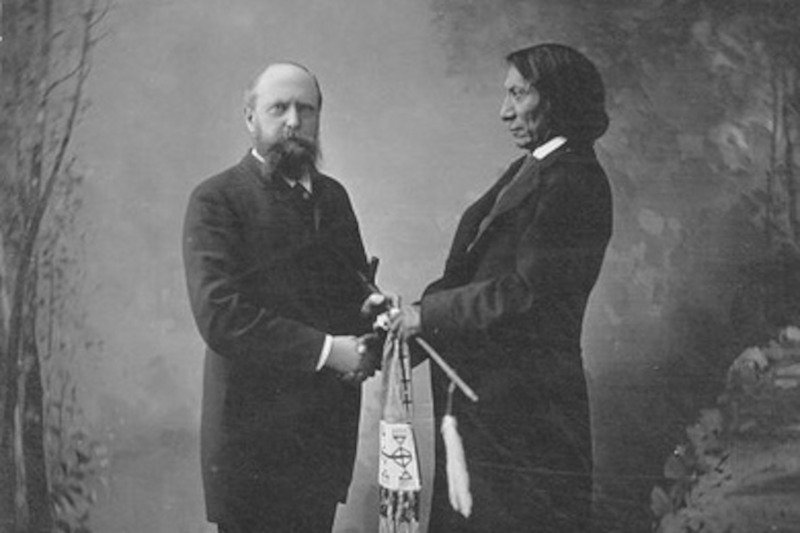
Maybe what the American people see through are politicians of the likes of Jordan. Red Cloud saw through shoddy U.S. justice. For him, while tragic, it was easy. In the 1890s, the U.S. government had promised to provide the starving Sioux supplies they depended on now that their hunting grounds had been stripped from them, the buffalo herd nearly eradicated, and the U.S. farming initiatives pushed on them failed. Yet, the food the corrupt government Indian agents distributed to them was rotten and the supplies defective. The Indians could tell. They were dying from it. Jordan’s sleights of rhetoric and slip-knot logic is trickier to pin down. As we Americans wade further into this new phase of U.S. truth and justice, we, sadly, are getting lots of practice trying.
- This oath for senators and representatives is identical: “The oath used today has not changed since 1966 and is prescribed in Title 5, Section 3331 of the United States Code. It reads: ‘I, AB, do solemnly swear (or affirm) that I will support and defend the Constitution of the United States against all enemies, foreign and domestic; that I will bear true faith and allegiance to the same; that I take this obligation freely, without any mental reservation or purpose of evasion, and that I will well and faithfully discharge the duties of the office on which I am about to enter. So help me God.’ . . . [T]he phrase ‘so help me God’ has been part of the official oath of office for non-presidential offices since 1862.” https://history.house.gov/Institution/Origins-Development/Oath-of-Office/ ↩︎
- The Guardian of Every Other Right: A Constitutional History of Property Rights, by James W. Ely, Jr., New York: Oxford University Press. ↩︎
- Jordan rebuffed a subpoena to testify to the J6 committee without repercussion; Bill and Hillary Clinton eventually complied with their subpoenas under threat of being charged with contempt of Congress. Both Clintons testified before the House Oversight Committee February 26 and 27 respectively, overseen by the chairmanship of the champion of truth James Comer. ↩︎
- Each member of the committee was allotted five minutes to ask Jack Smith questions. Those five minutes included the time Smith took to answer. ↩︎
- No one was under oath at that hearing but the man dyed deep in sin, Jack Smith. ↩︎
- The obvious glitches in the transcript of Hageman’s speech were ironed out. To hear her, see https://www.youtube.com/watch?v=EdHfPqCTOgs beginning at 4:34:49. ↩︎