A God That Fits
“I’m a blatant speciesist.”
If they could talk, members of no other species would express such outright intolerance. It’s the idiosyncrasy of the human species to consider itself alone, among the 8.7 million eukaryotic species currently in operation on Earth, to have significance. In its eyes, the value of all other life-forms correspond to the utility they provide the human when whole and the profit rendered from parts when sundered.
Whether the human is the most significant species is irrelevant. The fact that it thinks it is has jeopardized the global ecosystem. To understand why the human holds itself in such high regard requires only a few moments’ reflection. It starts and ends with the qualities of the human brain, indisputably unique among life on Earth. That brain imposes on its possessor a sense of self distinct from other life-forms, in the world but not of it. Which creates problems.
The human beheld the world as an enormous commotion caused by agents it could clearly see were not itself.
When the human emerged from the evolutionary tree, the first thing it did was look about. In doing so, it beheld the world as an enormous commotion caused by agents it could clearly see were not itself. This sense of self distinct from the environment was the result of the human brain’s capacity to register disparate sensations differentiated by distance and time, retain those sensations, and combine them to apprehend a reality of co-existence. To explain, perhaps it would be best to bring in a cat.
The human detects a cat and ascertains immediately that it is over “there” based on two rudimentary perceptions: distance and time. That the human is aware of distance separating itself from the cat requires little explanation. The time element does. Because the human brain cannot give primary focus to itself and the cat simultaneously, it must abandon focus on itself to shift attention to the cat. That shift registers in the human brain as a sequential occurrence of two experiences, introducing the time factor that reinforces the human’s conviction that the cat is indeed over “there.” Yet, in focusing on the cat, the human mind retains its sense of self and location. The coincidence of disparate perceptions — over distance through time — causes the mind to forge a world of dimension that contains, besides itself, distinct and co-existent entities.
The cat has no such capacity to retain and synthesize sequenced impressions of self and others, therefore does not perceive itself as separate from the world. The cat remains of a piece with the commotion it causes, fully integrated with the sound and color whirling around it. Rather than move through the kaleidoscope as humans do, it is fated to move with it.
That, in a nutshell, is the difference between humans and non-humans, the speciesists and the species they despise.1
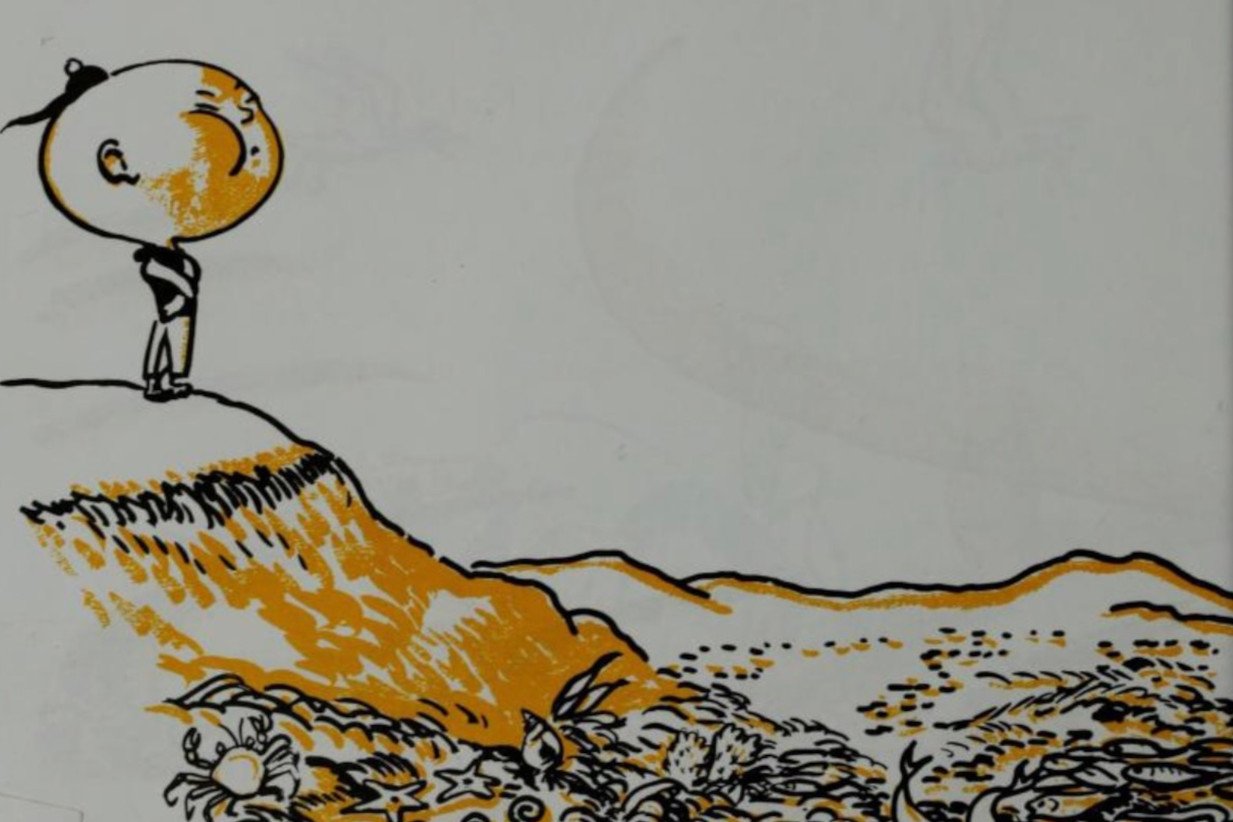
As a rule, big things don’t fit into little things. Think of the boy in the Chinese folktale who could swallow the sea.
The emergence of the speciesist would have been unlikely without the development of another singularity of the human brain, its notion of God, which in itself presents an ontological impossibility.
As a rule, big things don’t fit into little things. Think of the boy in the Chinese folktale who could swallow the sea. The enormously incongruent relationship of these two physical entities — a boy and the sea — is what makes the story splendid and absurd. How could so much get into something so small? The illustrative advantage of the folktale’s vivid imagery vanishes when we attempt to consider an incongruence between abstractions. How could the big idea of God get into so little a brain? The brain’s smug answer: It just does.
That doesn’t satisfy the ontologist. While God is reputed to be infinite, ubiquitous, and eternal, the human mind is known to be fallible, feeble, and puny. Any classical philosopher will point out: No effect can be greater than its cause, ergo, no finite human brain could come up with the notion of infinite God. And yet the idea of God is indubitably lodged deep within the human brain. Not to worry. Theologians can handle that: The human didn’t think up God; God revealed Himself to the human. Instead of addressing the obvious next question of how God could fit in there, human heads swelled, not from having absorbed the notion of God, but from a euphoric sense of their own importance. They obviously weren’t the wimps they appeared to be if God wanted to be friends with them. In fact, the more they learned about their special Pal, the more extraordinary they turned out to be.
Take, for example, God’s looks. This was no God of hamsters, wild ponies, albatrosses, bumblebees, or nematodes. He was the God of humans because, it was revealed, he looked just like them. That made them feel real good. But he only looked like some of them. That’s where things got tricky. God, they found out, was a guy and had made human guys in His image. He added gals later when He realized something was missing. But God doesn’t forget things. Making gals later was His way of saying: Gals are nice, but extra.
As a result of this and some other hitches — like God being a white guy — things got off to a shaky start. For example, the latecomer, the gals, it was proclaimed, had been created to do what only they could do: bear young, which meant they would also be cooking, sweeping, scrubbing, and gathering berries, with bed and board thrown in. It was also proclaimed that the darker humans had been created to work plantations, with bed, board, and Sunday school thrown in, sometimes.
With fellow humans made to suffer so dreadfully under this scheme, just imagine what happened to the salamander. While women and slaves eventually threw off the worst of the burdens the white human male insisted they bear, “lower” forms of life simply began to disappear.
Rumors circulated that God’s stewards were hogging it all, leaving insufficient resources for the species that had survived the stewards’ ravages so far.
Unfortunately, humans also found out they were in charge — of everything.
Although the planet had gotten on well without any conspicuous supervision for four billion years, word got around that God had charged the human to serve as steward of His wide and varied creation. The philosopher John Locke concurred, instructing his fellows to feel free to use whatever animal, vegetable, or mineral matter they required to survive and prosper. After all, it was there for their benefit.
Things went rapidly downhill after that. Unleashed, the inexhaustible human imagination devised methods, techniques, and technologies to dredge, drill, drain, pump, plow, thresh, fell, mash, husk, tan, winkle out, or detonate whatever they thought might — not ensure their survival, which had been achieved some time ago,2 but bolster business. Soon rumors began circulating that God’s stewards were hogging it all, leaving insufficient resources for the species that had survived the stewards’ ravages so far.3
This is where speciesism came into its own. The creatures that God’s stewards had been charged to tend — the fish of the sea, the fowl of the air, the cattle, and every creeping thing that creepeth upon the earth4 — did not know God, else what need for a guardian? In not knowing God, they were pagan, and it had been established long ago that pagans, once caught, had two options: convert or die. Since those lower life-forms showed no signs of converting, their deaths, in serving the pleasure of the creature who did know and glorify God, would please God as well. It was bombproof logic.
It was wretched logic. Hamstrung by the stillborn monstrosities of their own stunted fantasy — towers of cement, clots of wire, networks of roadways, combustable-engine machines, power stations, parking garages, convenience stores, individually wrapped Twinkies, six-packs, and landfills holding the discharge — God’s mob of speciesists turned to their sophisticated laws to push aside the remaining lower life-forms blocking their way. To hell with the interdisciplinary work between ecologists and economists explaining the many essential ways frogs, wolves, vultures, bats, and bacteria support humanity’s survival. Speciesists vigorously discounted, then defunded their work. To hell with the endangered greater sage-grouse. Its habitat on federal public lands5 across eight Western states of the USA was stripped of protections December 22, 2025, to make way for construction of the Greenlink North transmission line slated to wipe out sage-grouse nesting and mating grounds. Further threatening the beleaguered bird’s existence, the livestock industry put pressure on the powers that be to remove the grass-height standards shielding its nesting habitats in Nevada, California, and Idaho.6 The sage-grouse’s nearly 80% drop in population since 1968 did not matter. Its imminent extinction did not matter. The greater sage-grouse did not matter. The bird, after all, did not know God.
So how does a boy swallow the sea? Easy. In a folktale. How does the mighty and precious concept of God fit into a human brain? Easy. It doesn’t. It took centuries for God’s stewards to boil the God concept down to a brained-sized notion they could serve up as a meager deity that glorified the speciesist.
To achieve any stature as creatures fashioned to behold — not contain — God, we might start by pondering what lies outside time, outside space, beyond the universe, and way beyond humankind. It is probably there, if anywhere, that God dwells. That is to say, beyond our ken.
- For a contrary opinion, please consult Being and Time, the magnum opus of German philosopher Martin Heidegger, a key document of existentialism first published in 1927. ↩︎
- Perhaps wealth had not been happily distributed, but there was no question that the resources required to survive were there. ↩︎
- Rumor also had it that some humans — those pigeonholed in Africa and the lower counties of West Virginia — had been left in questionable circumstances. ↩︎
- Genesis 1: 26, King James Bible. ↩︎
- Please note, no reference is ever made to the greater sage-grouse’s lands. ↩︎
- https://biologicaldiversity.org/w/news/press-releases/trump-guts-protections-for-greater-sage-grouse-in-eight-western-states-2025-12-22/ ↩︎