You Cannot Fly Away
“Free as a bird.”
We say that because birds can fly and we cannot. But free? Hardly. Birds have to fly. The smaller ones, the ones weighing no more than a few grapes, the ones we love the most, are skittish creatures, constantly on the lookout. At the slightest hint of danger, they are in the air.
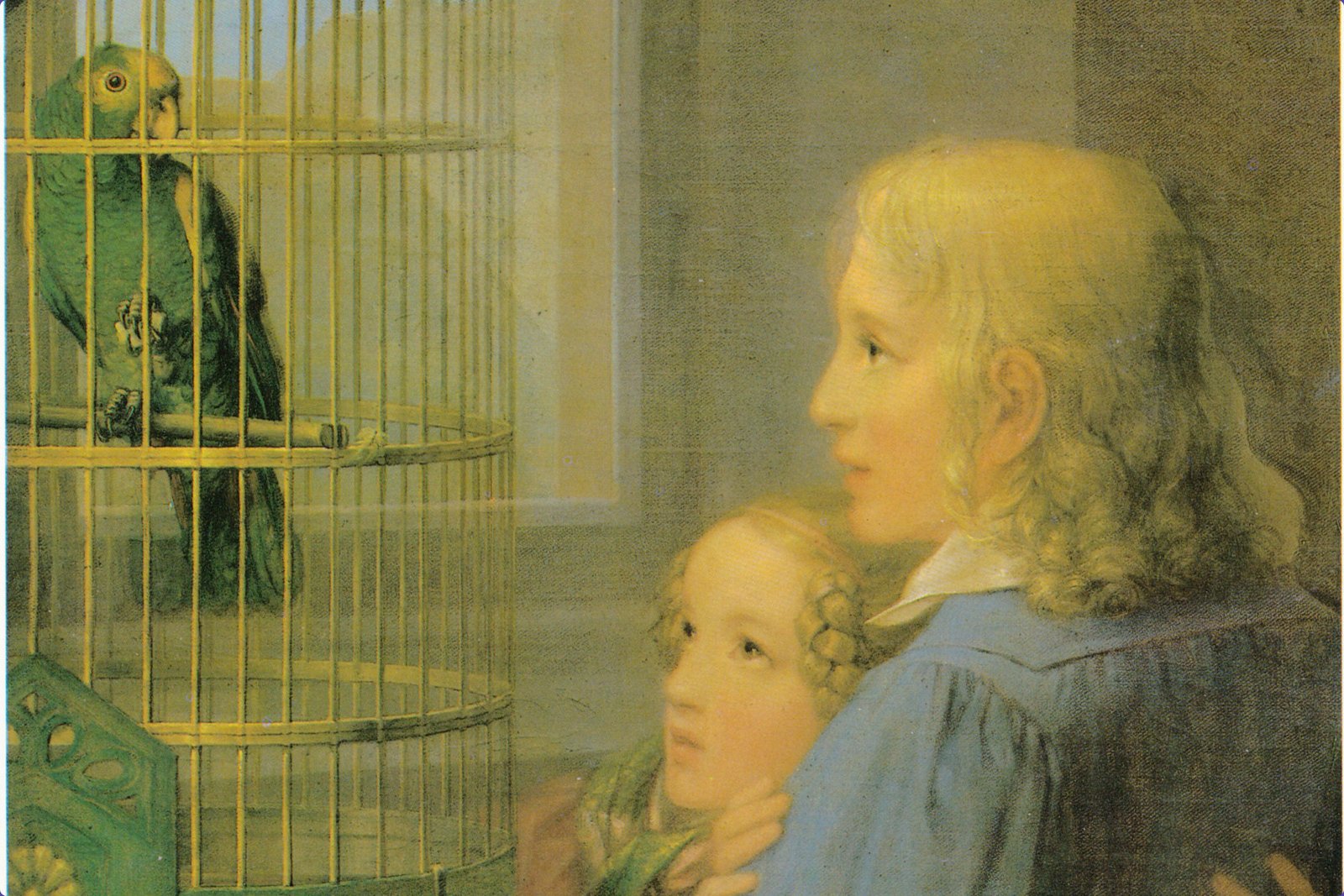
Flying is hard work. Large birds are reluctant to take wing. Pity the poor swan bound to heave its girth heavenward. Humans can walk, stroll, saunter, but they seldom sprint — and usually train beforehand. Flying is an all-out operation every time, and the smaller birds, prey of all the world, dart about constantly. Their burden is laid to rest the moment we cage them, which we like to do so we can watch them. But caged, they no longer do what we so admire, fly. As the months pass, we don’t even see them in there anymore. Those quick, scintillating creatures have become lethargic and drab as wallpaper. Then they die, dusty, crusty, shabby, lonely, and — what we’ll never know — heartbroken. The poor body of the human being suffers a similar fate.
We humans are the only creatures in the Animal Kingdom to be hampered by conscious minds, which enables us to separate things that belong together, like body and mind. The mind is esteemed as supreme. The body gets no credit as the essential component enabling the mind to both create and inhabit a human sphere of existence. We certainly don’t attribute to the body any defining influence on our human experience, which we elevate to moral, ethical, and spiritual realms. We ignore the implication of the body’s extraordinary role of cradling the mind.
By subjugating the body to the whims, preferences, and abuses of the mind, we consign it to a cage of sorts. It cannot get out. Magnificent as it is, it can do no more than what we tell it to: ingest whatever we feed it, idle for months on end as we pursue conveniences, comforts, and binges of every imagining. The fact that it survives each extravaganza proves our contention that it always bounces back. Despite its well-known and relatively simple requirements, the body goes without because those requirements involve time and exertion, and it doesn’t seem to matter anyway. It does bounce back. As the years pass, we ride arrogant as gods, reckless as goblins the magnificent creature bottled within, never suspecting any reversal of that relationship possible.
Fashion goes a long way toward helping us work out a look we approve of, but we fail and end up, tragically and against our will, looking year after year more and more like ourselves.
Rather than salute, we tend to ignore, mock, disparage the body. We need to. It is, after all, frightfully frank. It exposes to all the world our contours and dimensions, the measure of our stride and reach, if we glide or bob, are soft or taut, slouched or upright, slick or awkward. While the most indifferent stranger takes in our every nonstandard feature at a glance, we are excluded from this all-too public survey of our corporal casing. Whether entering a restaurant or waiting to cross the street, we alone remain ignorant of our physical impact.1 Hence, we are inclined to dismiss the body that engenders that impact (usually, as we learn, not quite up to what we would prefer) as having nothing to do with us.
Fashion goes a long way toward helping us work out a look we approve of, but we fail and end up, tragically and against our will, looking year after year more and more like ourselves. On the other hand, our minds are wily, elusive, chameleon-like, self-deluding, smoke-and-mirrors entities we use as getaway vehicles. A perfect foil to the body, the mind does not disclose its powers at sight. Taking a seat next to Stormy Daniels would be the tale of a lifetime, while we remain oblivious of our terrific good fortune in getting to sit beside David Graeber2 or Professor Donald P. Schneider.3 It’s the difference between a painting and a book. You take in a painting in a moment and know if you like it or not. You look at a book and nowadays are supposed to judge it by its cover, but the adage still holds true: you cannot. You have no idea what’s inside. To find out takes time, concentration, and a commitment to partner with the author to extract the sense and recreate the experience the author coded into those pages in the form of words and sentences. Such is the difference between the advertising nature of body and the impenetrability of mind.
And so the seat of the intellect sails incognito through life, riding its neglected body like the wind, getting conveyed effortlessly through whatever activities, misadventures, and foolhardy errands might occur to it. Our miraculous vehicle shows no sign of wear or tear; picks up and carries on no matter how deprived it may be; is hardy, robust, pliant. It is, veritably, the chariot of an earth-bound god. We glory in our jaunt.
If our body is to go for a walk, we have to go with it. We are the dog and the dog walker. What a nuisance.
Those of us lucky enough to get a good, long ride will begin noticing something going wrong. We find we are not conveyed at the customary speed or with the customary ease. Our glorious chariot is beginning to hitch and squeak. The resilient cuticle that carried out all of our wishes at command has begun to pull, shrink, harden, tire, fail. Rather than making our every wish come true, it has become the limiting factor, the reason we forgo those wishes. To our horror, we learn that the squeaking, pulling, and hitching will not stop nor can we dump our chariot or exchange it. We are bound to stay put and resort to maintenance, not to renovate, which we learn is not an option, but to prevent it from deteriorating faster.
Unfortunately, that maintenance cannot be accomplished by taking our complex equipage into the shop for a quick oil change and lube job. Nor can we stretch those cramped muscles, perform a mini-workout, or do the needed cardiovascular remotely. If our body is to go for a walk, we have to go with it. We are the dog and the dog walker. What a nuisance.
Another unhappy truth we run up against is the exacting condition that this body of ours — this miracle turned monster — requires attention every day. If we don’t provide that, what’s gone wrong will only get rapidly worse: the bones will continue to crunch down onto the nerves trapped between, the muscles will continue to contract, the joints to stiffen. What’s the surprise? If you don’t dust regularly, guess what accumulates. And you don’t water your house plants once a year. But who would have thought that the once uncomplaining, infallible, obedient, immaculate steed inside us would engage in the sin of aging and require attention. Yikes.
As the master bows to serve the menial, a stiff upper lip is in order. No matter what we do, the body will continue to harden, shrink, fold up, close down. As it does, we harden, shrink, fold up, and close down with it, day by day, millimeter by millimeter. The care we give the body now can only influence how long that process will take, with our perverse wish being that it take a very long time. But there is no need to despair. We will miss nothing. We will be there, tethered to our magic machine, to watch the tide go out. At that point we will have absorbed the strange knowledge that our cage was inside us all along and we inside it, and as it sinks, so must we. Down, down to Davy Jones’ locker we go. Our solitary hope is that our song rises to drift elsewhere.
- The single and interesting exceptions to this are actors. Through their work, they are very aware of their appearance, movement, and physical impact. How would this knowledge of themselves, a blindspot for everyone else, change the equation to their advantage in social encounters? ↩︎
- David Graeber was an American anthropologist, anarchist activist, and author of “Debt, The First 5,000 Years.” He died in 2020 at age 59 from what is suspected to be complications related to Covid-19. ↩︎
- From Pennsylvania State University, Professor Schneider is No. 1 in H-index ranking, with an H-index of 269, if you know what that is. ↩︎